
TweakTown Review: R6101C 7.68T SSD - The Magic of Compression
With the advantages that transparent compression tech brings to the table, many enterprises can dramatically benefit from what DapuStor's R6101C can do.
Introduction and Drive Details
DapuStor has launched a new variant within the company's Roealsen6 Series. The new SSD, like the others within the Roealsen6 Series, is built on Gen5 DP800 controller and advanced firmware. The series features a PCIe 5.0 interface and 3D eTLC NAND Flash across the board. Supporting the NVMe 2.0 protocol, the R6 Series can deliver up to double the performance of the best PCIe 4.0 SSDs.
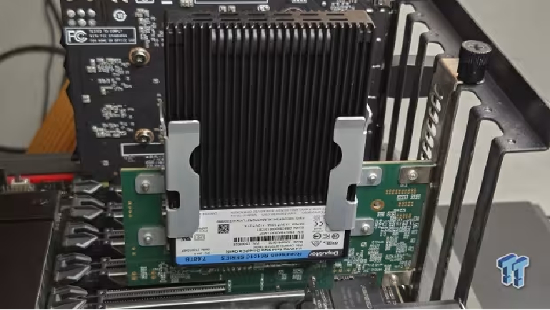
DapuStor's Roealsen6 R6101C SSD is built with an application processor and transparent compression module, giving this SSD a massive advantage over conventional SSDs when the data being digested is compressible in nature. The R6101C integrates advanced hardware compression and scalable capacity to achieve up to a 4:1 compression ratio, 3.5x capacity expansion, and 4x random write performance gains.
Now, we have a new player entering the ring to contend for compression supremacy. Leveraging inline compression, DapuStor's Roealsen6 R6101C SSD achieves lower latency, higher IOPS, and superior performance-to-power efficiency. At a 4:1 compression ratio, its random write performance is up to 4x faster than non-compressed NVMe SSDs.
Additionally, the R6101C dynamically adjusts physical storage based on data compressibility, and depending on the compressibility of the data in play, this special SSD can store up to more than triple its logical capacity. According to DapuStor, its R6101C SSD, under ideal conditions, can deliver up to a mind-bending 18-DWPD of endurance.
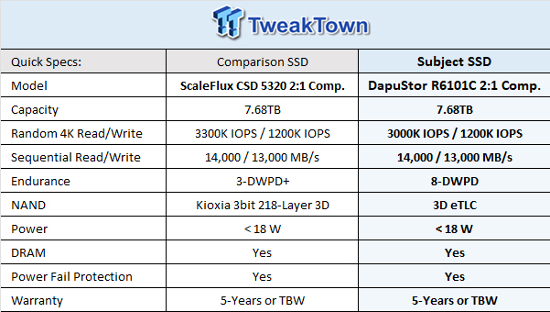
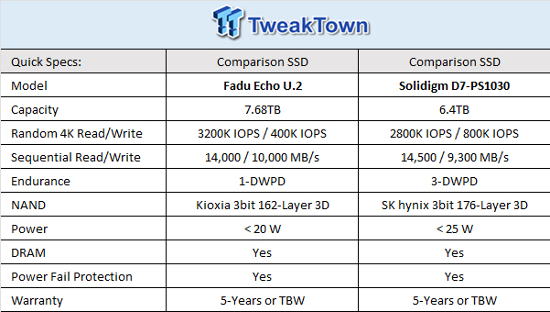
Now that we've covered the compression advantage as it relates to power efficiency, footprint, and TCO, let's see what DapuStor's Roealsen6 R6101C 7.68TB PCIe Gen5 x4 U.2 SSD can do for you by the numbers with a 2:1 compression ratio, and importantly, how this SSD compares against ScaleFlux's groundbreaking CSD 5320 SSD.
Specs/Comparison Products
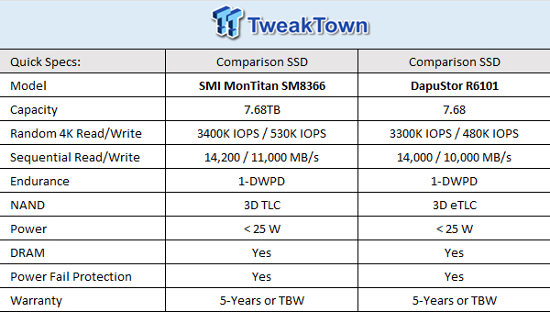
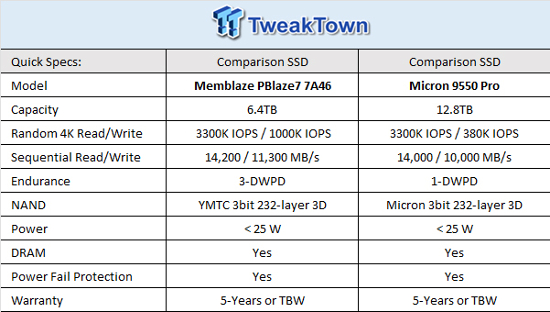
DapuStor Roealsen6 R6101C 7.68TB PCIe Gen5 x4 U.2 SSD
The drive we have in hand is a 1-DWPD design, U.2 form factor, 7.68TB in capacity, 3D eTLC arrayed, and 16-channel DP800 controlled. This configuration is rated for up to 3 million IOPS and up to 14 GB/s sequential throughput. DapuStor SSDs are compatible with major operating systems such as RHEL, SLES, CentOS, Ubuntu, Windows Server, and VMware ESXi.
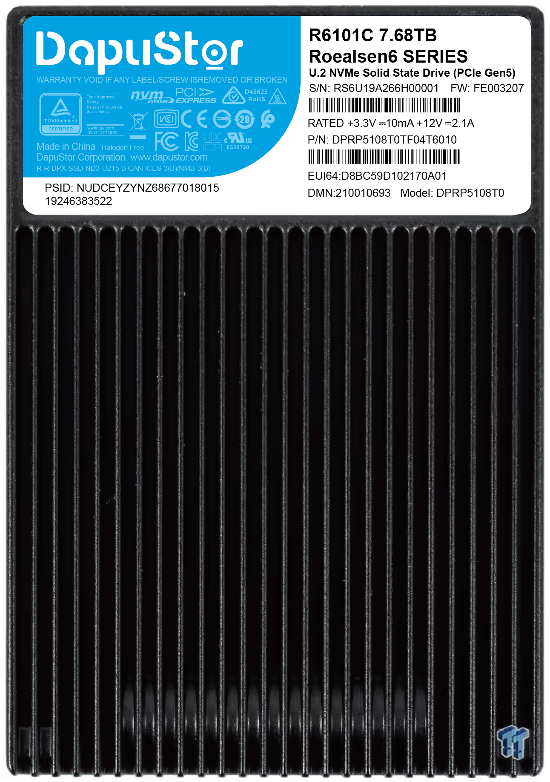
Advanced features include transparent compression with multiple compression ratio configurations. NVMe 2.0 - enabling online firmware upgrades, up to 128 name spaces, atomic writes, and more. OCP 2.5 telemetry, latency monitoring, and NVMe-MI send/receive. NVMe-MI 1.2, end-to-end data protection, secure boot, thermal throttling, and more.
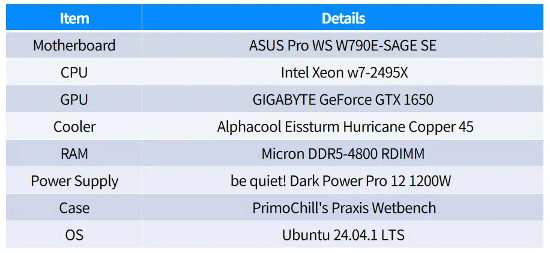
Test System Specs
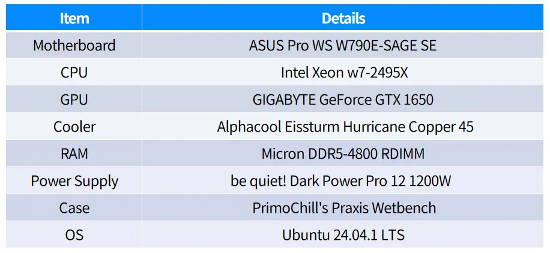
Enterprise SSD Test System
Benchmarks - Sequential
128K Sequential Write/Read
DapuStor factory specs its R6101C 7.68TB as capable of delivering up to 13,000 MB/s 128K sequential write throughput when 2:1 compression is in play. We are getting up to 14,200 MB/s, so factory spec here may be on the conservative side. This is by far the fastest rate we've encountered from any single PCIe Gen5 x4 SSD, being more than 1,100 MB/s faster than the CSD 5320. Impressive.
128K Seq. Read Avg. MB/s
128K Seq. Read Avg. Latency
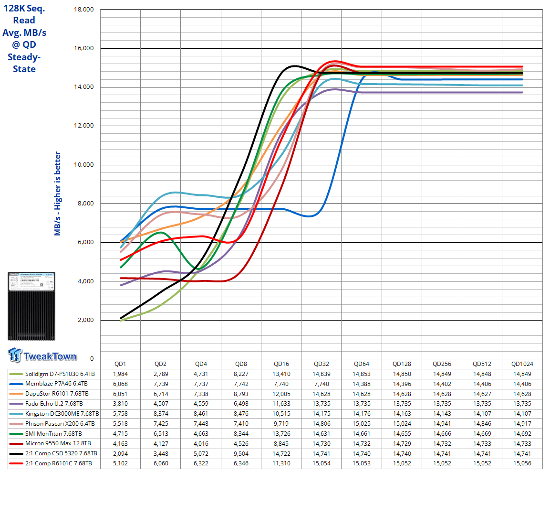
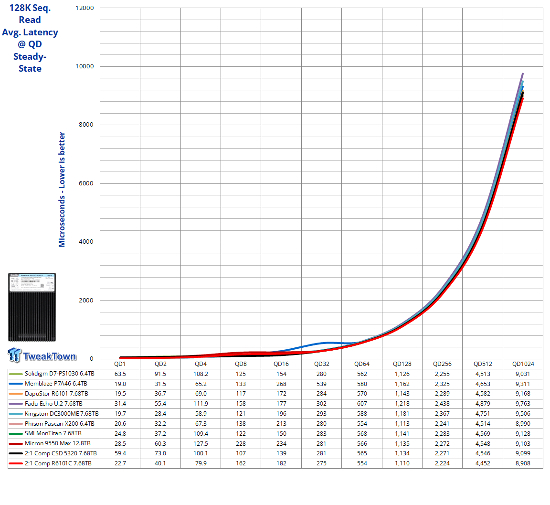
Here, the drive is factory spec'd for up to 14,000 MB/s 128K sequential read throughput. We are hitting up to 15,050 MB/s, which is another lab record for a single PCIe Gen5 x4 SSD. The performance curve here is among the best we've encountered to date.
Benchmarks - Random
4K Random Write/Read
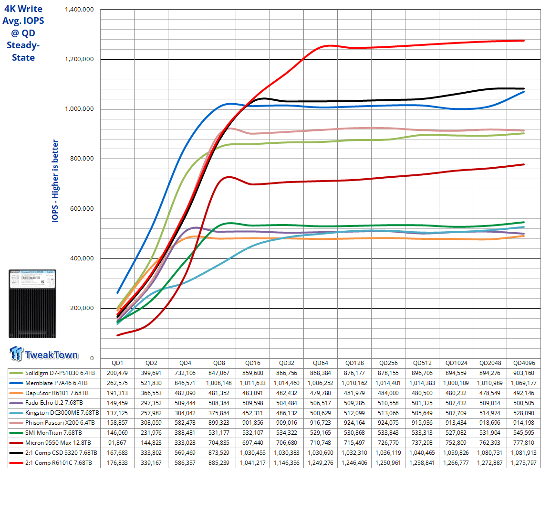
Factory spec here at 2:1 compression is up to 1,200K IOPS. We are getting up to 1,275K IOPS, so again, even better than advertised, and again, a new lab record. The performance curve here is easily the best we've ever seen for its kind. Keep in mind that this is a 7% OP SSD. Amazing.
4K Write Avg. IOPS
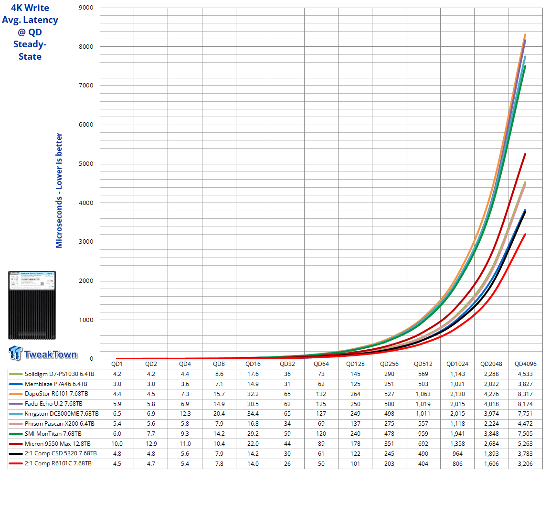
4K Write Avg. Latency
Factory spec here is up to 3,000K IOPS at QD512. We are getting 2,356K at QD512 with our configuration. This is significantly lower than factory spec; however, a pure 4K random read scenario is a very unlikely implementation for this type of SSD to find itself in, and we aren't even sure if it exists in the wild. So no worries here.

4K Read Avg. IOPS

4K Read Avg. Latency
4K 7030
Here, our contender delivers what we consider the second-best performance curve we've ever seen coming from a flash-based SSD, second only to the CSD 5320, which shares a similar technology. However, in terms of the highest throughput we've ever measured coming from a flash-based SSD, our test subject is number one.
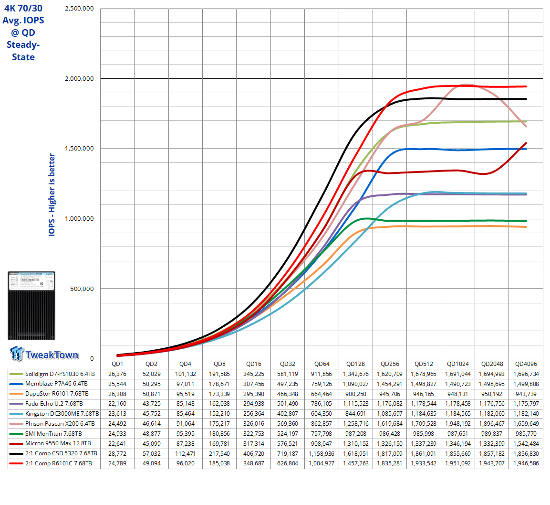
4K 70/30 Avg. IOPS
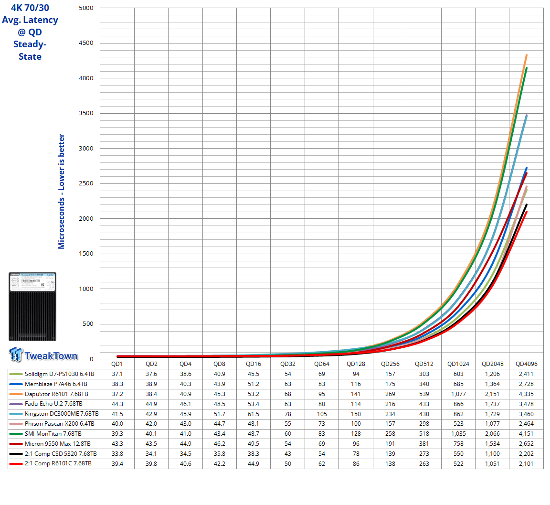
4K 70/30 Avg. Latency
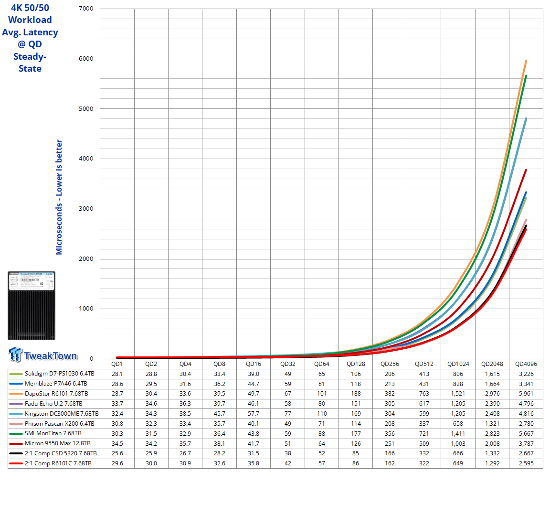
4K 5050
As we add more programming into the mix, our test subject responds again with what we consider the second-best performance curve we've ever seen coming from a flash-based SSD. Again, second only to the CSD 5320, which shares a similar technology. Again, in terms of the highest throughput we've ever measured coming from a flash-based SSD, our test subject is number one.
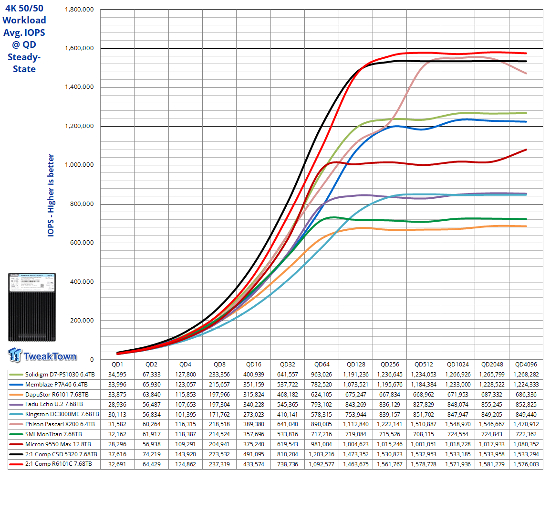
4K 50/50 Workload Avg. IOPS
4K 50/50 Workload Avg. Latency
8K Random Write/Read
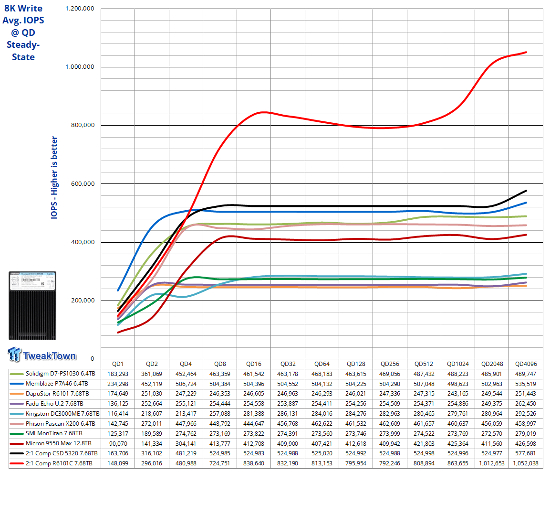
We expect 8K random to track pretty much the same as 4K random here, just at a lower IOPS rate because it's moving twice the amount of data. Incredibly, our test subject, when programming data with 2:1 compressibility, can deliver up to a million IOPS here. This is double the throughput of any conventional flash-based SSD we've encountered and nearly double what we are getting from the CSD 5320. Amazing.
8K Write Avg. IOPS
8K Write Avg. Latency
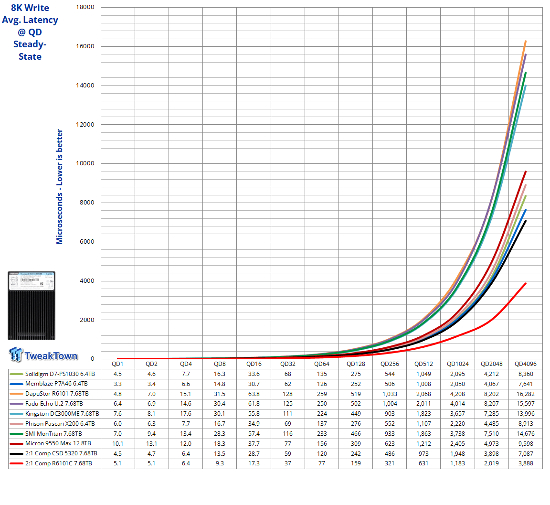
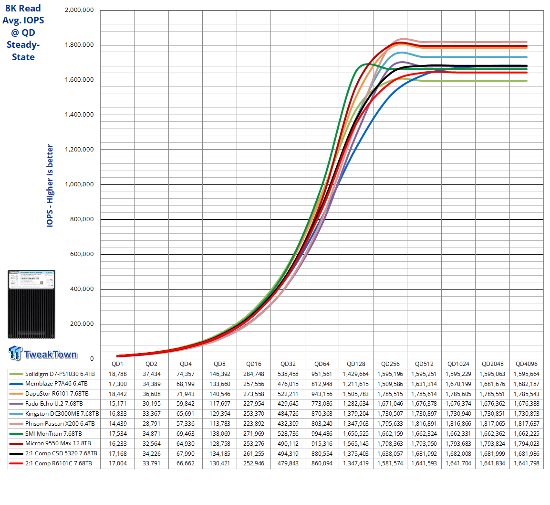
Excellent performance curve here - better than we saw at 4K. Here, our test subject is running neck and neck with the CSD 5320 - keeping within 40K IOPS of its main competition at the top end.
8K Read Avg. IOPS
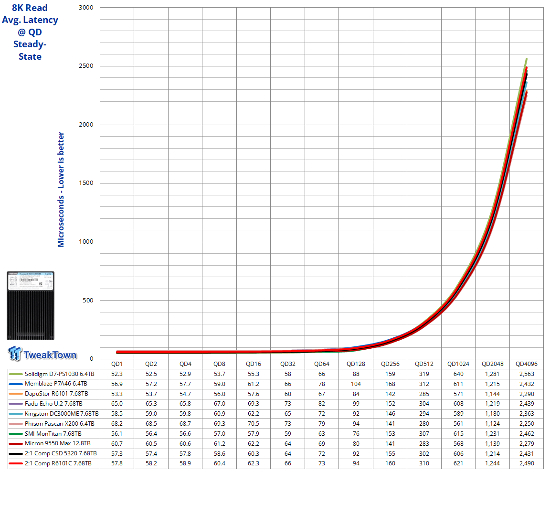
8K Read Avg. Latency
8K 7030
8K 7030 is representative of a common database workload. If your database can be compressed at 2:1, there is no SSD that can deliver higher performancethan our test subject. This is another lab record for the highest throughputcoming from a flash-based SSD. Incredible.
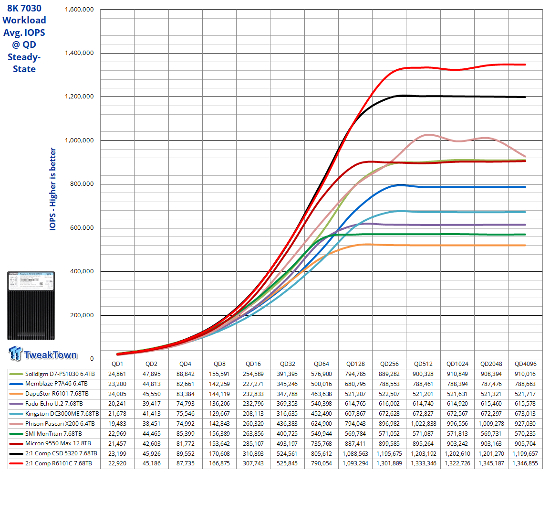
8K 70/30 Workload Avg. IOPS
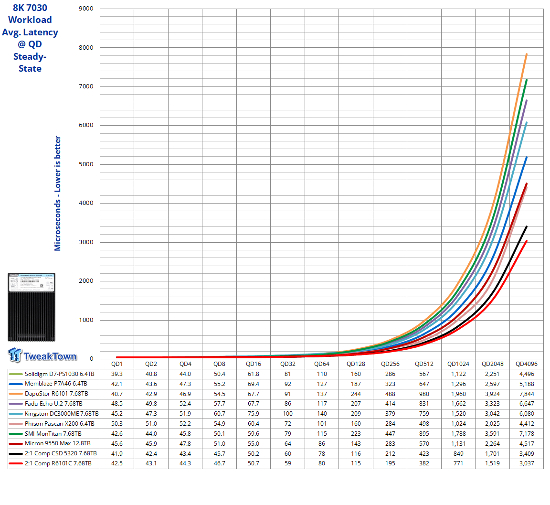
8K 70/30 Workload Avg. Latency
8K 5050
Again, if 2:1 compression is in play, no TLC arrayed SSD we've ever encountered can deliver a better 8K mixed performance curve and do so where it matters most.
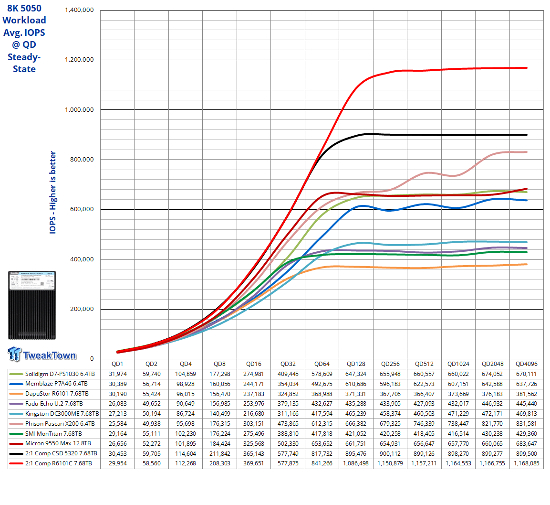
8K 50/50 Workload Avg. IOPS
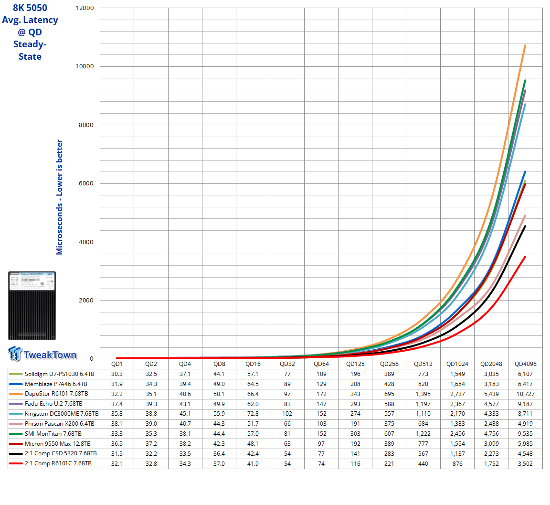
8K 50/50 Workload Avg. Latency
Final Thoughts
If your enterprise can benefit from transparent on-device compression technology, then we are of the opinion that employing SSDs such as DapuStor's Roealsen6 R601C is a must. It and those of its kind are up to 4x more efficient in every TCO metric that matters than any conventional SSD, including potentially up to 18x more endurance. Enough Said.
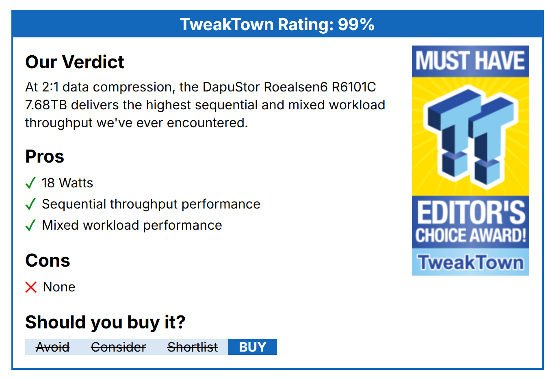
DapuStor's Roealsen6 R601C 7.68TB has delivered the highest sequential throughput and the highest mixed workload throughput we've ever encountered from any flash-based SSD. Editor's Choice.
DapuStor's Roealsen6 R601C 7.68TB has delivered the highest sequential throughput and the highest mixed workload throughput we've ever encountered from any flash-based SSD. Editor's Choice.
*Source: TweakTown Author - Jon Coulter (Senior Hardware Editor) > Read the full review on TweakTown