
TweakTown Review: R6060 E1.L 245.76TB SSD - Massive Capacity with Fast Retrieval
This review was written by Jon Coulter, Senior Hardware Editor at TweakTown. Read the full review on TweakTown
DapuStor's R6060 Series QLC SSDs offer massive capacity, modern form factors, and superior retrieval speeds, reaching a new level of efficiency.

Introduction and Drive Details
Massive capacity is all the rage for many read-intensive applications. First, we got 61.44TB PCIe Gen4 QLC SSDs, then 122.88TB PCIe Gen4 QLC SSDs, and now 245.76TB PCIe Gen5 QLC SSDs are the newest cutting-edge standard. Think of it, it takes only four SSDs for a full petabyte of storage - amazing. The efficiency at this level of capacity is unparalleled, with a single 2U storage server capable of supporting a mind-bending 10 petabytes of storage.

With the rise of the 245.76TB SSD, comes an order of magnitude greater efficiency than ever before possible. Physical footprint and watts per petabyte are the primary drivers of TCO, especially as related to read-intensive applications in the modern data center, and 245.76TB SSDs have just doubled the efficiency in this regard.
With that said, let's focus on our test subject, DapuStor's Roealsen6 R6060 E1.L 245.76TB SSD. The E1.L form factor exists to maximize density in the server rack. This form factor exists within constraints that make cooling the drive more difficult than most other form factors. In general, the E1 formfactor tends to run hotter than others.
Pictured above are several instances of temperatures taken nearing the end of 2-loops of 128K sequential write preconditioning, where we feel temperatures are likely their highest. Using only air cooling, we consistently received temperature readings that peaked at a relatively cool 51 °C. Impressive, especially for the E1.L form factor. This indicates to us that cooling this SSD doesn't present a difficult challenge whatsoever.
DapuStor describes its R6060 Series enterprise SSDs as follows: "DapuStor R6060 QLC Series is powered by PCIe Gen5 DP800 controller and 3D eQLC NAND, supporting NVMe 2.0 and advanced FDP features. Built on a high-bandwidth PCIe 5.0 architecture, R6060 delivers ultra-high capacity, high read performance, and low power consumption. It enables higher storage density and optimized TCO for AI, cloud, and data center applications."
The company further states: "The R6060 leverages NVMe 2.0 and FDP technology to maximize eQLC potential. It empowers the host with precise data placement control, drastically reducing Write Amplification (WA) to enhance both speed and endurance - offering the ideal balance of performance and cost for QLC scenarios."
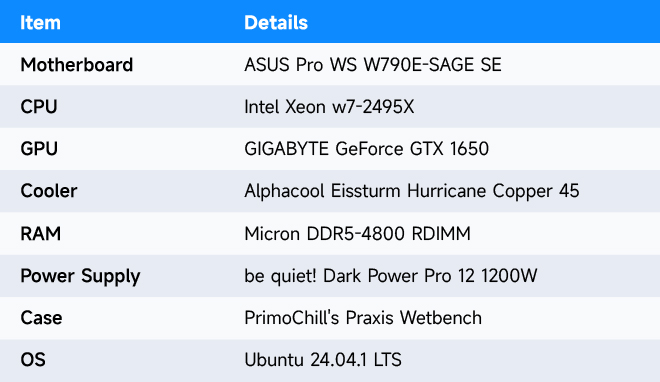
Okay, now that we are familiar with some of the main features and thermal characteristics DapuStor's Roealsen6 R6060 E1.L 245.76TB SSD brings to the table, let's see what kind of performance it can deliver via our Xeon powered enterprise test bench.
Specs/Comparison Products


DapuStor Roealsen6 R6060 E1.L 245.76TB PCIe Gen5 x4 SSD


The drive we have in hand is a 0.6-DWPD design, E1.L form factor, 245.76TB in capacity, eQLC arrayed, and 16-channel controlled. This configuration is rated for up to 2.1 million IOPS and up to 14 GB/s sequential throughput. DapuStor Roealsen6 R6060 Series SSDs are compatible with major operating systems such as RHEL, SLES, CentOS, Ubuntu, Windows Server, and VMware ESXi.
Test System Specs
Enterprise SSD Test System
Benchmarks - Sequential
128K Sequential Write/Read

128K Seq. Write Avg. MB/s

128K Seq. Write Avg. Latency
DapuStor specs its R6060 245.76TB E1.L SSD as capable of delivering up to 3,600 MB/s 128K sequential write throughput. We are getting up to 3,662 MB/s, so the factory spec seems to be spot on. The drive is the fastest of its type here that we've encountered to date.

128K Seq. Read Avg. MB/s

128K Seq. Read Avg. Latency
Here, the drive is factory spec'd for up to 14,000 MB/s 128K sequential read throughput. We are hitting up to 14,283 MB/s, so it is a bit better than advertised and at a place where throughput matters most for read-intensive applications. Looking at the chart, we can see a clear advantage that PCIe Gen5 brings to the table as compared with the rest of the PCIe Gen4 SSDs that populate our chart. Roughly twice the throughput potential. Impressive.
Benchmarks - Random
4K Random Write/Read

4K Write Avg. IOPS

4K Write Avg. Latency
4K random write performance is not advertised, only 64K random write, which is what we used to precondition the drive, because at 4K preconditioning would take roughly 70 days due to the capacity of our test subject. Performance here at 4K is expected to be significantly lower than it is at 64K IU, but surprisingly, we are still very close to the quoted 16K IOPS at 64K.

4K Read Avg. IOPS

4K Read Avg. Latency
Factory spec here is up to 2,100K IOPS. We are getting up to 2098K with our configuration. Again, factory spec is spot on.
4K 7030

4K 70/30 Avg. IOPS

4K 70/30 Avg. Latency
This type of workload is not what this type of SSD is designed to tackle, so results here are mostly irrelevant.
4K 5050

4K 50/50 Workload Avg. IOPS

4K 50/50 Workload Avg. Latency
Again, this type of workload is not what this type of SSD is designed to tackle, so results here are mostly irrelevant.
8K Random Write/Read

8K Write Avg. IOPS

8K Write Avg. Latency
8K random write performance is not advertised, only 64K random write, which is what we used to precondition the drive, because at 8K preconditioning would take roughly 35 days due to the capacity of our test subject. Performance here at 8K is expected to be significantly lower than it is at 64K IU, but surprisingly, we are still very close to the quoted 16K IOPS at 64K.

8K Read Avg. IOPS

8K Read Avg. Latency
Outstanding performance curve here. This is where our test subject is at its best - 8K random reads, where we find our test subject cranking out the most IOPS we've encountered coming from a QLC arrayed SSD. Outstanding.
8K 7030

8K 70/30 Workload Avg. IOPS

8K 70/30 Workload Avg. Latency
8K 7030 is representative of a common database workload. Again, this type of workload is not what this type of SSD is designed to tackle, so results here are mostly irrelevant.
8K 5050

8K 50/50 Workload Avg. IOPS


8K 50/50 Workload Avg. Latency
Again, this type of workload is not what this type of SSD is designed to tackle, so results here are mostly irrelevant.
Final Thoughts
Fast data retrieval is where much of the action in the modern data center is taking place, and DapuStor's ultra-high-capacity QLC SSDs make for one of the most compelling choices available today. Especially compelling is its exceptional sequential read throughput as well as its 4K and 8K random read throughput where it delivers more than any of its kind that we've ever encountered.
It's the best of its kind that we've encountered to date. Editor's Choice.