
DapuStor E1.S Liquid-Cooled SSD | Efficient Thermal Management for High-Density AI Data Centers
As AI and high-performance computing (HPC) workloads evolve, data center rack power consumption is increasing from the 10 kW range toward 100 kW. At these power densities, traditional air cooling is approaching its physical limits in efficiency, space, and system stability. Liquid cooling is increasingly becoming essential to the thermal management of AI data centers.
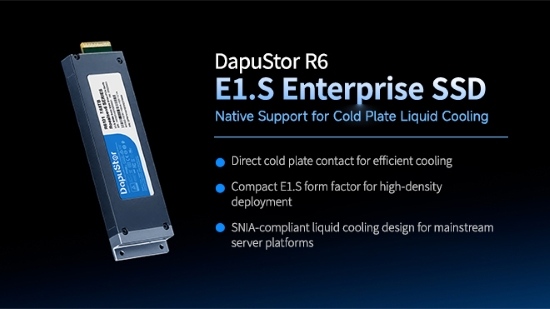
Enterprise SSDs run 24/7 under relentless AI workloads, generating substantial thermal loads at scale. DapuStor introduces the R6 E1.S enterprise NVMe SSD, supporting native cold plate liquid cooling, to deliver efficient thermal management and reliable storage for high-performance, scalable AI data centers.
01 | Why AI Data Centers Adopt Liquid Cooling
As AI computing demand grows, liquid cooling is moving from emerging technology to large-scale deployment. According to TrendForce, its penetration in global AI data centers is expected to increase from approximately 33% in 2025 to 53% in 2026. Compared with air cooling, liquid cooling offers several benefits:
● Efficient thermal performance to keep server operation stable;
● Reduced space requirements enable flexible deployment and higher rack density;
● Lower power consumption and total cost of ownership (TCO).
Among several types of liquid cooling techniques, cold plate cooling is the mainstream approach, accounting for more than 85% of the market. Unlike immersion solutions, cold plate liquid cooling removes heat through direct contact between cooling plates and heat-generating components. It offers high compatibility with existing rack structures, manageable costs, and ease of maintenance, making it a preferred choice for current AI data center deployments.
02 | Storage Thermal Management: E1.S SSDs and Cold Plate Liquid Cooling
In data centers, a large number of SSDs support critical AI workloads, including KV Cache offloading, model loading, and Checkpoint writes, consistently under high-power operation. High temperatures can cause SSD performance to degrade or even fail, leading to service disruption and GPU stalls.
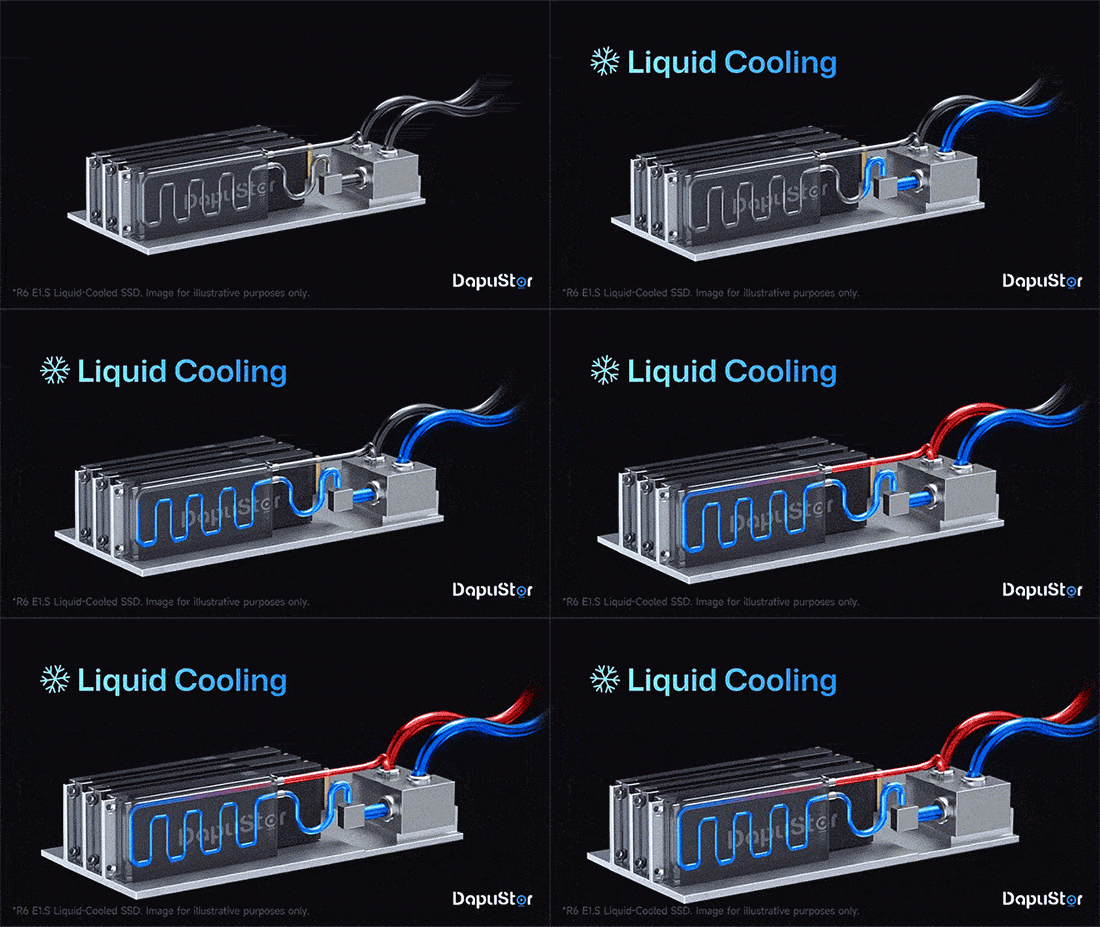
Cold plate liquid cooling is especially ideal for high-density E1.S SSD deployments. With a compact form factor and power consumption of up to 20W per drive, E1.S SSDs can experience thermal throttling under air cooling. A cold plate attached directly to the drive enclosure efficiently removes heat under intensive workloads, unlocking the full performance potential of the SSD.
To advance standardization, in December 2025, SNIA released the SFF-TA-1006 Rev 2.0 specification, defining cold plate liquid cooling design requirements for E1.S drives, enabling open and scalable deployments.
03 | DapuStor E1.S NVMe eSSDs: Native Support for Cold Plate Liquid Cooling
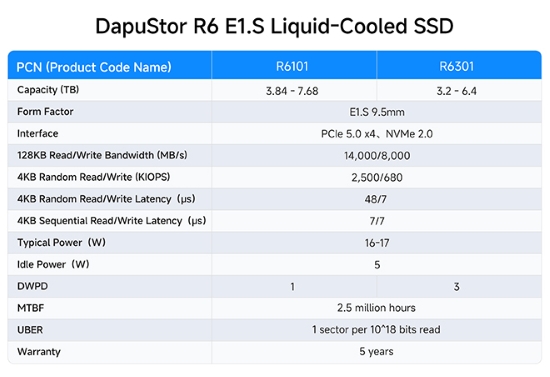
Designed for efficient thermal management, the DapuStor R6 E1.S liquid-cooled SSD supports native cold plate support and is compatible with mainstream AI server architectures. The product delivers enterprise-grade performance for high-density AI and cloud data centers.
● Native Cold Plate Liquid Cooling: Enables stable thermals under intensive AI workloads, maintaining peak SSD performance and increasing rack density.
● AI KV Cache Acceleration: Delivers random read/write latency as low as 48/7 μs for fast, consistent data access in latency-sensitive AI inference.
● Enterprise-Grade Features: Supports NVMe 2.0, OCP 2.5, FDP, end-to-end data protection, and multiple data security mechanisms.
● Broad Ecosystem Compatibility: SNIA-compliant enclosure design aligns with NVIDIA and mainstream AI server platforms.
Liquid cooling is increasingly adopted across compute and storage, becoming an essential capability in modern data centers. DapuStor liquid-cooled SSDs, including the R6 E1.S, feature native support for cold plate to combine high-performance storage with efficient thermal management, making them an ideal choice for high-density, scalable AI data centers.
PRODUCT DOCUMENT