
SLC + QLC Dual-Mode SSDs: A New Approach to Balancing Performance and Capacity for AI Workloads
As AI workloads scale across data centers, training requires high-throughput access to massive datasets, while inference demands low latency for metrics such as time to first token (TTFT). High capacity, high bandwidth, and low latency must now coexist in a single storage system. Conventional architectures separate SLC and QLC, making it harder to scale performance and capacity efficiently.
DapuStor's SLC + QLC dual-mode SSD solution integrates both modes within each drive and uses software-defined media configuration to break the traditional trade-off between performance and capacity in an architecture built for AI workloads.
01 | The Dual-Mode Innovation: SLC and QLC within a Single SSD
1.How It Works: Intelligent In-Drive Mode Configuration
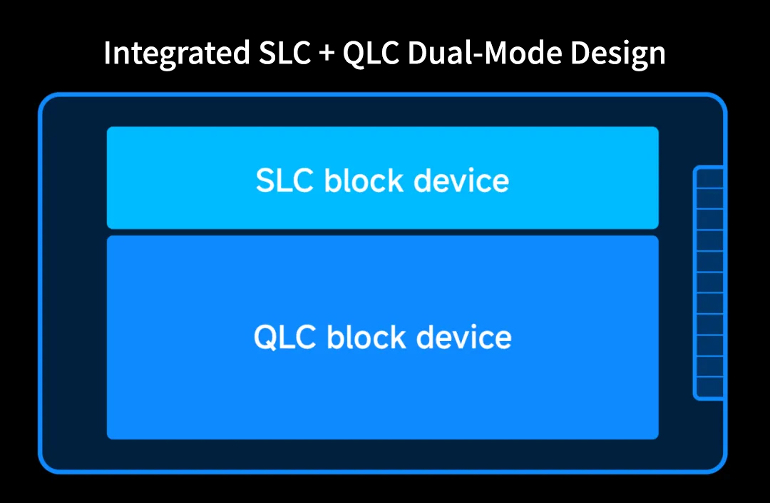
No dedicated SLC NAND is required. Through firmware and controller optimization, selected QLC cells operate in pSLC mode, creating a high-performance pSLC region alongside a high-capacity QLC region within a single SSD.
2. Flexible Capacity Allocation
The dual-mode design supports flexible SLC-to-QLC capacity allocation for different workload requirements.
Taking a 30.72TB QLC SSD as an example:
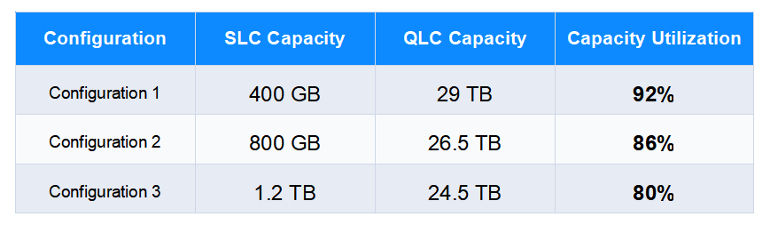
Compared with all-QLC operation, the dual-mode design adds high-speed SLC capacity while retaining most of the usable storage capacity.
02 | Six Advantages over Conventional Architectures
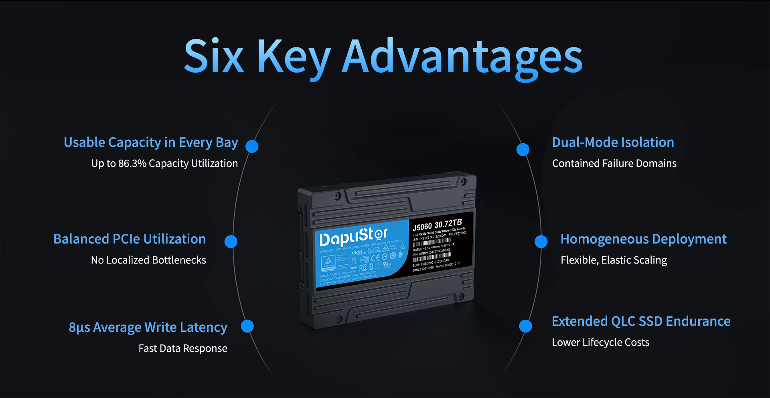
Separate SLC and QLC deployments consume drive bays inefficiently and underutilize system resources. The dual-mode architecture improves storage density while delivering six key advantages:
1.Higher Density and Performance
With dual-mode SSDs in all 24 bays, no bays are reserved for low-capacity SLC drives, maximizing server-level storage density.
Each dual-mode SSD delivers more than 7× the random-write IOPS of a QLC-only SSD. Unlike a conventional configuration with four dedicated SLC drives, all 24 dual-mode SSDs include an SLC region. At 800 GB per drive, a 24-bay server provides 19.2 TB of aggregate SLC capacity.
The result is greater rack-level capacity, more high-speed storage, and higher parallel throughput for hot data.
2.Balanced PCIe Utilization

In conventional 1:N (SLC: QLC) deployments, one SLC SSD handles write traffic for multiple QLC SSDs. Bursty workloads such as AI training can saturate its PCIe link while other links remain underutilized, limiting aggregate throughput.
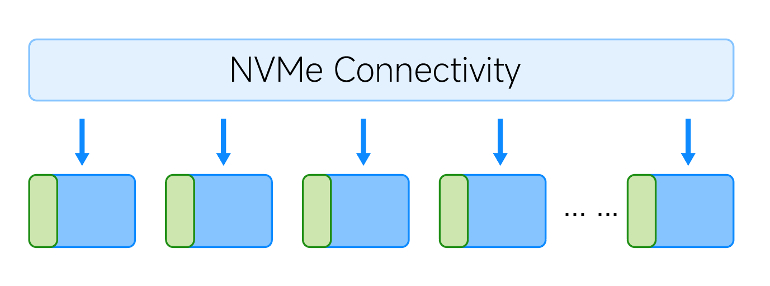
With 24 dual-mode SSDs, write traffic can be distributed across all 24 SLC regions. Under balanced conditions, each drive handles approximately 1/24 of the aggregate write load, reducing localized bottlenecks and improving cluster throughput.
3.Sub-8 μs Latency
Three firmware optimizations deliver fast, consistent SLC performance:
● Die-level isolation minimizes interference from QLC workloads.
● Optimized SLC reserve allocation reduces write amplification, improving endurance and steady-state performance.
● Region-aware I/O scheduling prioritizes latency-sensitive data across the entire data path.
By distributing writes across all drives, the dual-mode design avoids overloading a small number of dedicated SLC SSDs. In 4 KB random-write tests, the pSLC region achieved an average write latency below 8 μs, making it well suited to database journals, write-ahead logs (WALs), and metadata caches.
4.Contained Failure Domains
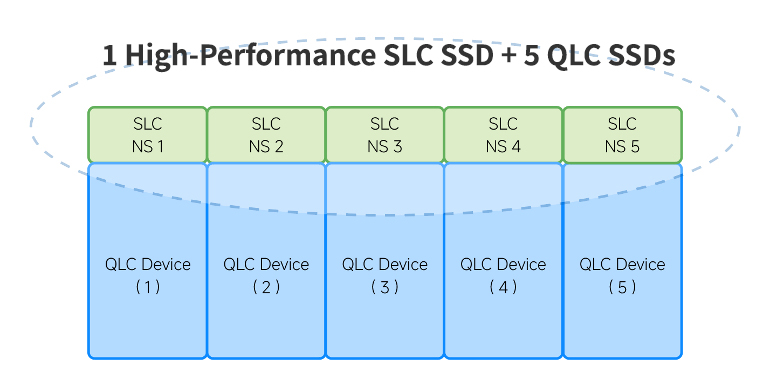
In a conventional 1:5 SLC-to-QLC architecture, the failure of one SLC SSD can affect data across five QLC SSDs —a failure domain exceeding 150 TB with 30.72 TB drives. Rebuilding this data can take days and degrade cluster performance.
With the dual-mode design, affected capacity is limited to a single drive, reducing rebuild volume by nearly 80% compared with the 1:5 architecture. This shortens recovery time, limits performance impact, and improves service continuity.
5.Simplified Deployment and Scaling
Conventional 1:N SLC-to-QLC deployments require a strict drive ratio: too few SLC SSDs limit performance, while too many reduce storage density. Maintaining this ratio during expansion also complicates load balancing and QoS management.
A homogeneous deployment of identically configured dual-mode SSDs eliminates ratio planning. Expansion requires only adding more drives, after which the cluster software rebalances data and workloads—reducing operational complexity and supporting elastic growth.
6.Lower TCO, Longer Endurance
Lower TCO
At 800 GB of pSLC per drive, a 24-drive system provides 19.2 TB of aggregate pSLC capacity without dedicated SLC SSDs, potentially reducing acquisition cost and overall TCO.
Extended Endurance
The pSLC region supports more than 25× the P/E cycles of QLC operation. High-frequency random writes are directed to pSLC, reducing write pressure on the QLC region. FDP—with host support—and enhanced wear leveling further reduce write amplification and distribute media wear. This extends drive life and lowers replacement and lifecycle costs across the storage cluster.
03 | Built for AI and Data-Intensive Workloads
● AI Training and Big Data
QLC stores large datasets, while SLC handles hot, write-intensive data. Keeping both regions within each SSD reduces host-level data movement between separate media tiers.
● Databases
For databases such as MySQL and Oracle, pSLC accelerates write-intensive logs while QLC provides cost-efficient capacity.
● Cloud and Virtualization
Each SSD supports concurrent VM startup and bulk data storage, simplifying cluster architecture.
A Simpler Path from HDD to Flash
HDD-based storage may require a separate TLC SSD cache to meet performance requirements. Dual-mode SSDs combine QLC capacity with built-in SLC acceleration, which can eliminate the need for an additional cache tier when replacing HDDs.
DapuStor's SLC + QLC dual-mode solution is now undergoing phased customer validation, with initial deployments in real-world workloads underway. As AI expands from model training to inference at scale, DapuStor continues to advance storage technologies for more efficient and reliable AI infrastructure.